Monday, April 20, 2020

MODEL DEVELOPMENT 2 - Developed Paper model and folding techniques Part 2 (Scale 1:10)

Paper Model 1:10

As per my previous attempt at model making, I wanted to explore the possibilities of the paper folding techniques and how I might accentuate them to create a better version of my space.

Important to my model making process is always how the architecture relates to the human being and thus the relationship between structure and end user should be explored. I started cutting out human figures using grey paper which had a thickness to them so that they were sturdy enough to stand.

Using an X-form span I had created, I began folding it in different areas to see how the form would collapse inwards. I found that I was able to create a somewhat 'square' ground-floor. I used glue to secure this form.

Later, I recognised a small opening in the X-form span and saw this as an opportunity to classify this as an entrance. I then constructed a masu box and used a steel ruler to cleanly cut an opening i the box. The existing triangular flaps which would normally secure the box now served as an abstract door.

The masu box was attached to the X-form spans. 

I also saw the the triangular shape of the X-form spans as an opportunity to integrate a V-pleat as a roofing. Cuts were made to experiment with the sense of light which enters the room. 
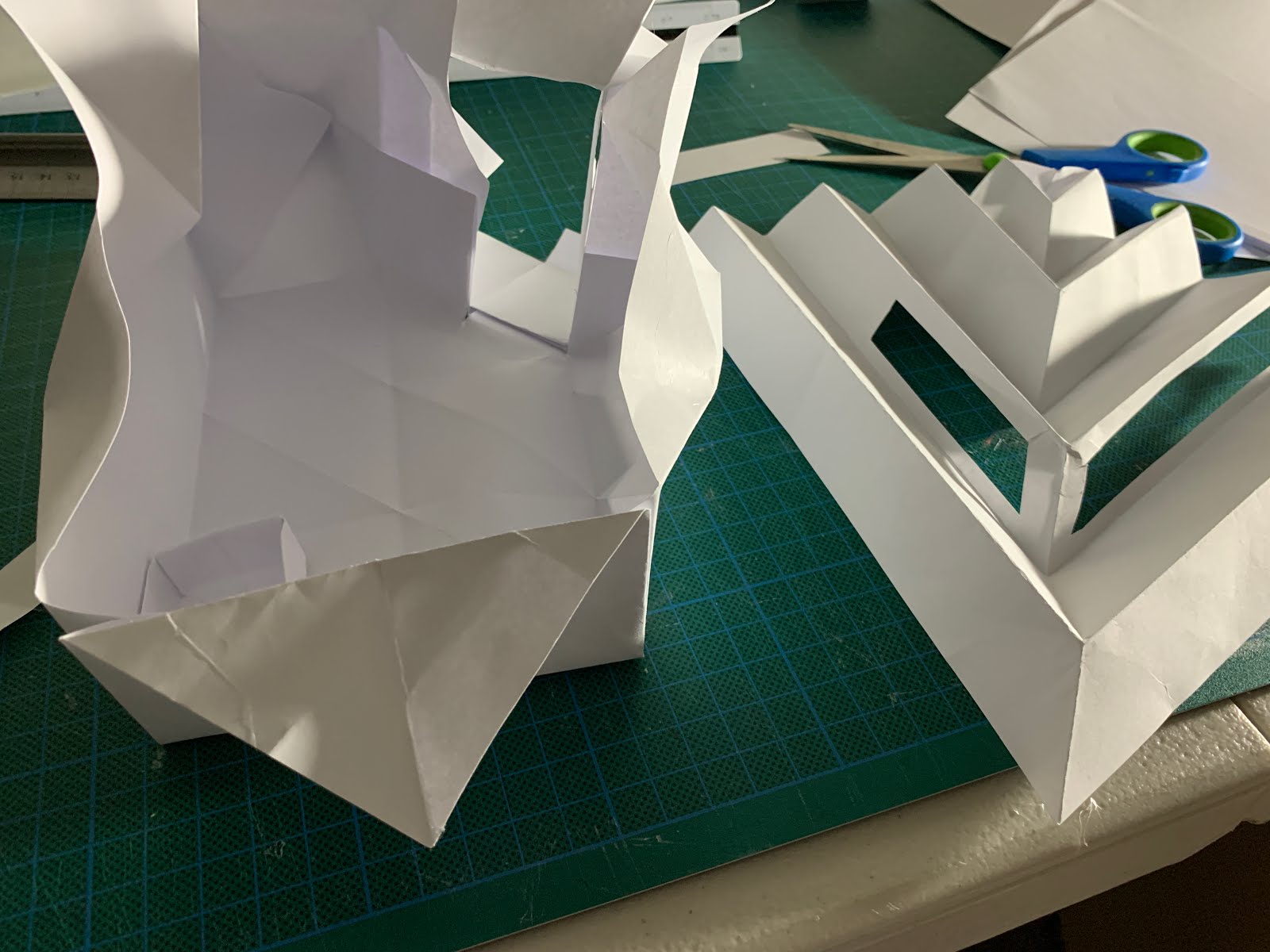

The main pieces of the paper model which were used to construct it

Photos

I had also considered adding two circular pillars to accentuate the entrance, but ultimately decided against it due to its clunky look.


MODEL DEVELOPMENT 1 - Developed Paper model and folding techniques Part 1

Using the paper folding techniques I had learnt during the week, I had attempted to make additions to my room in consideration of how I could integrate such folds to make a better version of my space.

I created templates for the 1:10 scale I was working at to make models more efficiently.


Overall, I wasn't too happy with the result as the paper folds such as dividing the paper, masu boxes and X-form spans were apathetically used as mere additions like furniture when I wanted it to have a more central focus.

Updated photos of Paper and Cardboard Models


Exploring my room, Sketching and Photography

To have a better understanding of my space, I uncovered my houses' floor plan to examine its general proportion and sizing...


and translated this into a rough sketch for model making and understanding how my space is currently used by me.

While it is normally a bedroom, I removed the bed and have already turned the room into a working, albeit messy, studio space for me to use.


The space has been particularly useful for this course in model making as well as in isolation in general due to quarantine.

Importantly, I needed to set up a means of photography to capture adequate quality photos for my model.

I used a A1 white cardboard sheet and taped it onto a cloth I had suspended.
Unfortunately, this setup did not have enough space for the models to stabilise flat and firmly for photography.

Hinges on my sliding mirror in my room...


... which I used to attach a white cloth onto by clipping them with bulldog clips.

I had also considered using two sheets of A3 foamcore has a suitable backdrop.
I ultimately decided against this and just used the sheet in isolation as the setup for photography as the two sheets created a 'horizon line' which meant the background of the models wouldn't be seamless.

Studio Week 5 Part 2 - Experimenting with Paper Folds, Study & Massing Models

Masu Boxes

By far, one of the most convenient folds I learnt were the Masu boxes which take up a 3D volume that can be used as massing shapes and forms quickly. I experimented with the different sizes using the A4 paper and the A3 sheets I had


Different back drops for photography with Masu Boxes of varying sizes.

Sketch Study Models - Massing

Natural Light 

Vs Artificial light...

 Experimenting with different forms -  this form somewhat resembles Jørn Utzon's Can Lis?

Jørn Utzon, Chen Hao · Can Lis, 1971-73 · Divisare
Can Lis in Spain, Majorca.


Spirals

Combining folding techniques... - Spiral inside two Masu boxes 


More Spirals...

V Pleats...

Spirals


Revisiting Masu Boxes - Massing with Gehry Residence influence.


X- Form spans - Perhaps my favourite new fold that I have learned...


Failed first few attempts - The form seams to wear out over time if the X's aren't consistently protruded outwards versus its 'valley folds' on the opposite plane.


Flexible at creating interesting forms... 
Experimental... and folds in numerous sporadic directions